
Monday, September 1, 2014

Sunday, August 24, 2014
Friday, August 15, 2014
Thursday, August 14, 2014
Monday, August 11, 2014
“Your only problem, perhaps, is that you scream without letting yourself cry.”
― Friedrich Nietzsche
― Friedrich Nietzsche
Thursday, August 7, 2014
"I want to attempt a terrible feminine. The cry of the revolt that is trampled underfoot, of anguish armed for war, of the demand for justice.
It is like the groan of an abyss that is opened: the wounded earth calls out but voices are raised deep as the bottom of the abyss, voices where are the bottom of the abyss crying.
Neuter. Feminine. Masculine.
In order to utter this cry I empty myself.
Not of air, but of the very power of sound. I raise up in front of myself my human body. And having cast on it "THE EYE" of a horrible measurement, part by part, I force it to re-enter me."
- Antonin Artaud
It is like the groan of an abyss that is opened: the wounded earth calls out but voices are raised deep as the bottom of the abyss, voices where are the bottom of the abyss crying.
Neuter. Feminine. Masculine.
In order to utter this cry I empty myself.
Not of air, but of the very power of sound. I raise up in front of myself my human body. And having cast on it "THE EYE" of a horrible measurement, part by part, I force it to re-enter me."
- Antonin Artaud
Tuesday, August 5, 2014
The Cry of Clytaemnestra
THE CRY OF CLYAETEMNESTRA from John Eaton on Vimeo.
"The opera compresses the events of Aeschylus’s play into a densely woven 80-minute sequence. The story is unfolded through the distorted visions of Clytemnestra (mezzo-soprano), who recalls and anticipates past and future events in dream-like succession....The music of the opera is intensely expressive, reflecting the psychological focus of the dramatic presentation. Scored for a 17-piece chamber orchestra (plus electronic tape), the work employs microtonal tuning in both equal-tempered quarter-tone tuning and, more occasionally, just intonation. Eaton distinguishes the two types for dramatic effect, associating the former with states of extreme psychological conflict and the latter with innocence and purity. Formally the opera is organized around a series of recurring, piercing cries emitted by Clytemnestra as she recalls the dreadful events that have overtaken her life. These provide an important element of musical unity and also serve to articulate the overall shape, punctuating the dramatic continuity; they also undergo transformations that mirror Clytemnestra’s shifting psychological orientation: from anguished horror at the opening in reaction to the sacrifice of her daughter, to ‘pure and terrifying’ exaltation at the end as she prepares for her husband’s return and murder. " -- Oxford Music Online
Sunday, August 3, 2014
"How can it be preserved, even by thought? How can thought be made the keeper of the holocaust were all was lost, including guardian thought? In the mortal intensity, the fleeing silence of the countless cry...
...Silence is perhaps a word, a paradoxical word, the silence of the word silence, yet surely we feel that it is linked to the cry, the voiceless cry, which breaks with all utterances, which is addressed to no one and which no one receives, the cry that lapses and decries. Like writing (and in the same way that the quick of life has already exceeded life) the cry tends to exceed all language, even if it lends itself to recuperation as language effect. It is both sudden and patient; it has the suddenness of the interminable torment which is always over already. The patience of the cry: it does not simply come to a halt, reduced to nonsense, yet it does remain outside of sense-- a meaning infinitely suspended, decried, decipherable, indecipherable."
- Maurice Blanchot, The Writing of the Disaster (1980)
********************************************
“Ha! To forget. How childish! I feel you in my bones. Your silence screams in my ears. You may nail your mouth shut, you may cut out your tongue, can you keep yourself from existing? Will you stop your thoughts?"
-- Jean-Paul Sartre, Huis Clos (1944)
*********************************************
...Silence is perhaps a word, a paradoxical word, the silence of the word silence, yet surely we feel that it is linked to the cry, the voiceless cry, which breaks with all utterances, which is addressed to no one and which no one receives, the cry that lapses and decries. Like writing (and in the same way that the quick of life has already exceeded life) the cry tends to exceed all language, even if it lends itself to recuperation as language effect. It is both sudden and patient; it has the suddenness of the interminable torment which is always over already. The patience of the cry: it does not simply come to a halt, reduced to nonsense, yet it does remain outside of sense-- a meaning infinitely suspended, decried, decipherable, indecipherable."
- Maurice Blanchot, The Writing of the Disaster (1980)
********************************************
“Ha! To forget. How childish! I feel you in my bones. Your silence screams in my ears. You may nail your mouth shut, you may cut out your tongue, can you keep yourself from existing? Will you stop your thoughts?"
-- Jean-Paul Sartre, Huis Clos (1944)
*********************************************
Saturday, August 2, 2014
"Certainly music traverses our bodies in profound ways, putting an ear in the stomach, in the legs and so on. It knows all about waves and nervousness. But it involves our body, and bodies in general, in another element. It strips bodies of their inertia, of the materiality of their presence: it disembodies bodies.....
Music, for its part, is faced with the same task, which is certainly not to render the scream harmonious but to establish a relationship between the sound of the scream and the forces that sustain it.......
If we scream, it is always as victims of invisible and insensible forces that scramble every spectacle and that even lie beyond pain and feeling. This is what Bacon means when he says, "I want to paint the scream more than the horror" If we could express this as a dilemma it would be: either I paint the horror and I do not paint the scream, because I make a figuration of the horrible; or else I paint the scream, and I do not paint the visible horror, I will paint the visible horror less and less, since the scream captures or detects an invisible force. Alban Berg knew how to make music out of the scream in the scream of Marie, and then in the very different scream of Lulu"
----Gilles Deluze
Music, for its part, is faced with the same task, which is certainly not to render the scream harmonious but to establish a relationship between the sound of the scream and the forces that sustain it.......
If we scream, it is always as victims of invisible and insensible forces that scramble every spectacle and that even lie beyond pain and feeling. This is what Bacon means when he says, "I want to paint the scream more than the horror" If we could express this as a dilemma it would be: either I paint the horror and I do not paint the scream, because I make a figuration of the horrible; or else I paint the scream, and I do not paint the visible horror, I will paint the visible horror less and less, since the scream captures or detects an invisible force. Alban Berg knew how to make music out of the scream in the scream of Marie, and then in the very different scream of Lulu"
----Gilles Deluze
Friday, August 1, 2014
Ingrid Sings
"The fundamental reaction against displeasure and anxiety has been, since the beginning of life, the scream. We are born screaming. The reaction we should expect for example from our dreaming Ingrid in her “primitive fear” which she compares to the “fear of newborn children” is the scream. But instead of screaming Ingrid sings.
In their physical aspect it is already evident that scream and song are intimately related. Tone — a basic element of song — is a scream of a specific character differing from the scream in the regularity of its vibrations, or expressed in psychological terms, differing in being submitted to a certain order. Tone compared to scream represents for this same reason, — always in its psychological aspect —, a renunciation of something instinctive (Triebverzicht). Instead of the unrestrained scream, which is on the one hand an aggressive expression of a respiratory-oral nature, arisen as a reaction or defense against the sufferings and anxieties caused by frustrations of instinctive needs, and which on the other hand is an expression of demand for the satisfaction of these instinctive needs, — instead of this unrestrained scream, the tone appears, which, physically, is a scream of regular vibrations and which psychologically we experience —compared to screaming—as being less aggressive, as a more erotic, less terrified, and less terrifying expression." - Heinrich Racker
"Music, then, is a sort of dreaming with the ear; and endless, subtly readjusting refinement of a shriek. At the beginning of any finite musical act there is pandemonium, a vast-omni-expressive noise in which are located all the sounds that the ear can hear; the musician simply elects a few possibilites out of this confusion of all frequencies and amplitudes. What is yearning? -- weakened terror. What is exhilaration? -- weakened terror. What is the soft cooing of lovers? -- weakened terror. A chord, a timbre, a snatch of song, is moving to the degree that it can allude to the primal scream that lurks behind it." -- Daniel Albright
How close?
Monday, July 28, 2014
"The scream is so intimately linked to pain that most adjectives describing it belong to the register of resonant space: one speaks of a “shrill scream,”“an acute pain”; one speaks of an insistent scream, an insistent pain. But what is a scream? Are we even sure that a scream is only a sound? We encounter here the same difficulty that we did when we approached the question of pain"
"Why not imagine the scream as a flux of energy gushing through the hole of the mouth considered as an erogenous ring? If we accept that the mouth is a libidinal orifice, we can consider that the flux of energy that runs through its center is a force defined in relation to another flux, to another force that runs along the lips. In other words, there would be a relation between the energy that passes through the center of the hole and the energy circulating around its edges. This relation between the scream and the erogenous edges of the mouth—between the gushing flux of the hole and the circulating flux on the border of the hole, between the surface (that is the void of the hole) and the orificial edge—was established by Stockes’s theorem in electromagnetic physics. With the aid of this theorem, we can con-clude that the flux flowing through the hole is equal to the flux running along the edge of the hole. Thus, there would be an equivalence between the energy of the scream and the sexual pleasure of the erogenous lips."
The Book of Love and Pain - Juan David Nasio
The Book of Love and Pain - Juan David Nasio
Friday, July 25, 2014
"The real Primal Scream is unmistakable. It has its own quality of something deep, rattling and involuntary. When the therapist suddenly removes any portion of defence and the patient is left naked with his Pain, he screams because he is wide open to the truth. Though the scream is the most usual reaction, it is neither the sole nor the perennial response to the sudden vulnerability to Pain. Some people moan, groan, writhe and thrash about. The results are the same. What comes out when the person screams is a single feeling that may underlie thousands of previous experiences....Sometimes the patient just needs to scream at first. He screams for the hundreds of shushes, ridicules, humiliations and beatings. He screams now because often he was wounded and wasn't allowed the luxury of bleeding. It's as though someone kept jabbing him with a small pin and could never once yell 'Ouch!'"
- Arthur Janov
****************************************
“there, manifest and stubborn (one hears only that) beyond (or before) the meaning of the words, their form…something which is directly the cantor's body, brought to your ears in one and the same movement from deep down in the cavities, the muscles, the membranes, the cartilages...The 'grain' is that"
- Roland Barthes
**********************************
“...from the most troubled of such dreams we awake with a shriek, a cry, in which the affrighted Will expresses itself most immediately, and thus enters at once and definitely, through the cry, into the world of sound, in order to manifest itself outwards”
-Richard Wagner
******************************************************
- Arthur Janov
****************************************
“there, manifest and stubborn (one hears only that) beyond (or before) the meaning of the words, their form…something which is directly the cantor's body, brought to your ears in one and the same movement from deep down in the cavities, the muscles, the membranes, the cartilages...The 'grain' is that"
- Roland Barthes
**********************************
“...from the most troubled of such dreams we awake with a shriek, a cry, in which the affrighted Will expresses itself most immediately, and thus enters at once and definitely, through the cry, into the world of sound, in order to manifest itself outwards”
-Richard Wagner
******************************************************
Thursday, July 24, 2014
"The struggle with the shadow is the only real struggle. When the visual sensation confronts the invisible force that conditions it, it releases a force that is capable of vanquishing the invisible force or even befriending it. Life screams at death, but death is no longer this all-too-visible thing that makes us faint; it is this invisible force that life detects, flushes out, and makes visible through the scream"
- Gilles Deleuze
- Gilles Deleuze
Wednesday, July 23, 2014
"Do you really hear nothing? Do you not hear the terrible voice screaming around us on every side, the voice known commonly as silence? Since I came to this silent valley I have heard it all the time, it won’t let me sleep, oh yes, Reverend, if only I could sleep again."
-- Georg Büchner - Lenz
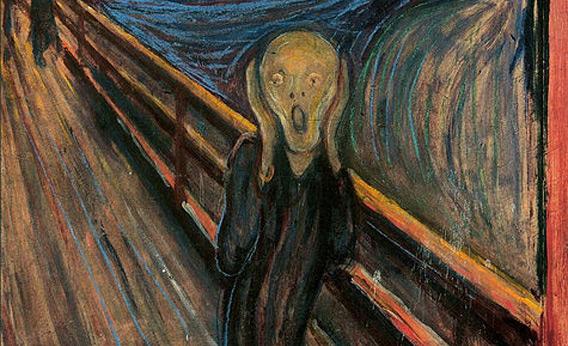
Edward Munch - Der Schrei der Natur (The Scream of Nature)
The Unbearable Lightness of Being - Milan Kundera
"It was no sigh, no moan; it was a real scream. She screamed so hard that Tomas had to turn away from her face, afraid that her voice so close to his ear would rupture his eardrum. The scream was not an expression of sensuality. Sensuality is the total mobilization of the senses: an individual observes his partner intently, straining to catch every sound. But her scream aimed at crippling the senses, preventing all seeing and hearing. What was screaming in fact was the naive idealism of her love trying to banish all contradictions, banish the duality of body and soul, banish perhaps even time..."
"It was no sigh, no moan; it was a real scream. She screamed so hard that Tomas had to turn away from her face, afraid that her voice so close to his ear would rupture his eardrum. The scream was not an expression of sensuality. Sensuality is the total mobilization of the senses: an individual observes his partner intently, straining to catch every sound. But her scream aimed at crippling the senses, preventing all seeing and hearing. What was screaming in fact was the naive idealism of her love trying to banish all contradictions, banish the duality of body and soul, banish perhaps even time..."

Sergei Eisentein's work was an inspiration to the artist Francis Bacon (1909-1992)

"Study After Velazquez's Portrait of Pope Innocent X" (1953)

Subscribe to:
Posts (Atom)